Heavy Timber Exposed Trusses – OBC
I love the look and added dimension of open ceilings with timber trusses. They aren’t typically used for structure in California due to strict earthquake structure requirements, but they look great and we can still use them.
Here you see a set of heavy timber trusses – Douglas Fir in this case – being installed in a ICF or insulated concrete form house.
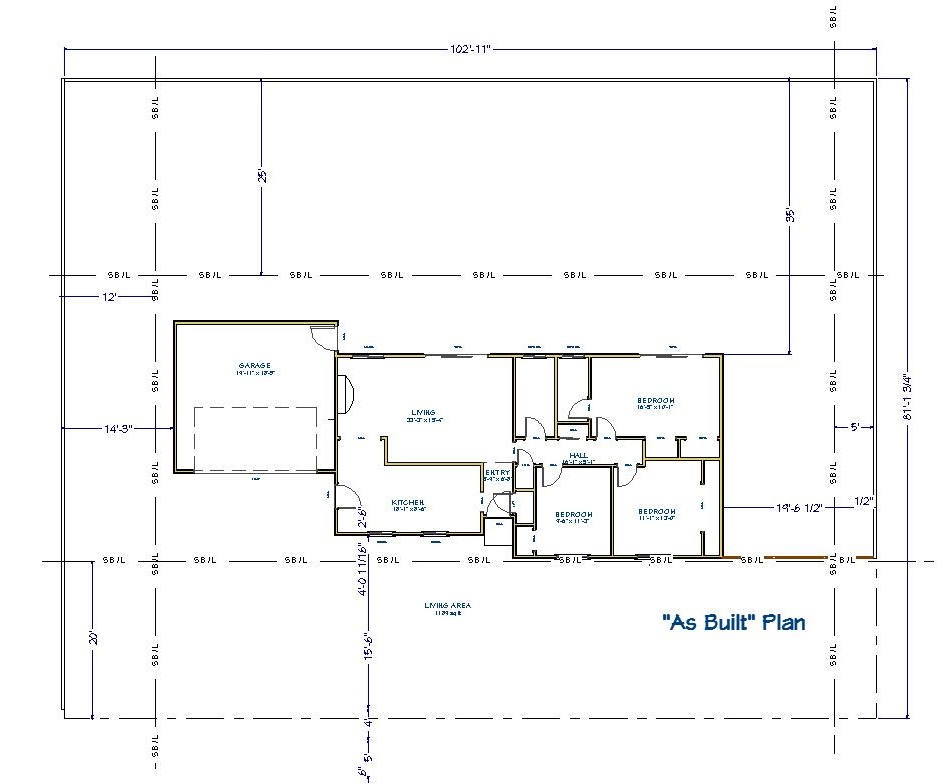
“As Built” Plans
The first step in figuring out how to remodel is to understand what you have! A remodel, by definition, means you already have a house, unlike new construction where you have a blank canvas.
So, I always create the “as built” plans myself (many architects have others do this for them.) One reason is that this way I can really get the feel for the home. How is it built? What kind of framing is used, where are the important structural areas, how has it been improved or added on to over the years, etc. Also every house has its own personality and I feel you need to experience it to understand the flow. All of this information helps inform ways that the house might be altered, added to or changed to suit the scope of the owner’s requirements.
So I go around the entire exterior – photograph everything – measure everything – note the siding, roofing, overhangs, foundation, driveways, hardscape, trees. Then with the outline of the building created, I go inside and figure out how the house is split up with interior wall.
The result is a 36 x 24 inch freehand drawing of the plan of the house.
Then, everything is entered into CAD (computer aided design) which I started using when it first came out in the 90’s. Originally CAD only did two dimensional drawings. Now when I input a house into CAD, I actually build a virtual model of the house in 3d. I can show you the inside and outside “virtually” and we can create various designs that you can actually experience before you start to build.
This is a complete game changer in helping you get the design you want.
Call me – lets talk about your project.
Thx Otis
Skinny, Tiny, Pre-Fab, Eco House

The “Skinny House” is an idea taken from looking at various pre-fab homes, in particular the high concept, prefabricated Glide House, designed by Michelle Kaufmann. Working with clients over the years, many had seen interesting prefabricated homes in Dwell Magazine and other online architectural place. The idea of having a home built in a factory – better working conditions – better quality – cheaper prices etc – is a hot appeal.
The Glide House

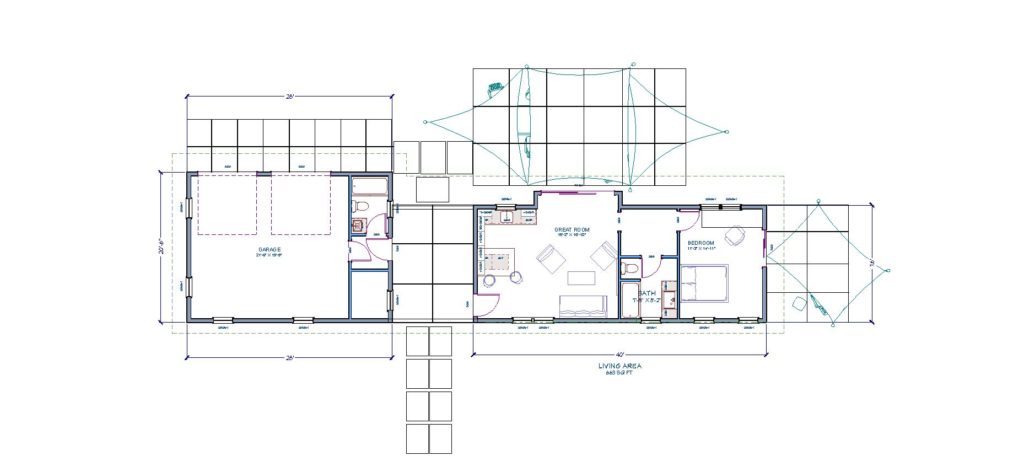
The plan below is an idea that uses many of the concepts of a prefabricated home but a bit bigger and using the garage as a “flex space.” Many people prefer using their garage as a studio, office or other use.

One of the ideas of the “Skinny House” is to incorporate outdoors living space.

Keep construction simple to keep costs down … simple but elegant!

Incorporate solar power …


Often times, after researching the true costs with infrastructure, foundations etc, the actual costs of prefabricated homes are the same or more than building the home on site. A site built home design has much more freedom to be “tweaked” to fit the site. Many options, levels of quality and design exist, but most prefabricated homes are based on components – usually 16 feet wide – that can be transported by truck.
Below – some additional ideas for floor plans.


Prefabricated home companies have been around for years. You mostly know them as trailer park homes. Many of these companies have not evolved past the ugly boxy designs you have seen. A bunch of new companies have come and gone such as Michelle Kaufmann’s Glidehouse. It seems to be – so far – a serious challenge to create the “iHouse” design for homes. A design that works everywhere – works well – is priced well and deliverable everywhere.
A bold objective …
Hygge – a friend of mine recently built this home in Long Island, New York
https://hyggesupply.com/supply/models/
Method Homes
https://methodhomes.net/homes/
Stillwater – in the state of Washington is an interesting company
https://www.stillwaterdwellings.com/designs
Ventana Magazine Features Ojai Custom Home Builder – Green Home
Contemporary Cool
The Ojai abode of green builder Otis Bradley.

By Andrea Kitay—Photography by Gaszton Gal
Casa Verde, the two-acre Ojai spread that Otis Bradley and his family call home, is more than a play on words. Its name is a nod to the custom homebuilder’s passion for efficiency. The 3400-square-foot contemporary completed in 2008 is a result of Bradley’s determination to build an ecologically sound home, in keeping with his family’s laidback lifestyle.
Continue reading “Ventana Magazine Features Ojai Custom Home Builder – Green Home”Building a New House in Ojai and Ventura County
Building in the City of Ojai is a fairly straightforward process. The town itself is quite small, only 4.4 miles, beyond those boundaries you are in the unincorporated area of Ventura County – a bit more challenging building process. Call us to help you navigate the building process.
Geography

Ojai is located at 34°26′57″N 119°14′48″W
The city is generally at 745 feet (227 m) above sea level.
According to the United States Census Bureau, the city has a total area of 4.4 square miles (11 km2), of which only 0.35% is water, and the rest is land.
Ojai is situated in a small east-west valley, north of Ventura and east of Santa Barbara. It is approximately 15 miles (24 km) inland from the Pacific Ocean coast.
Since Ojai is lined up with an east-west mountain range, it is one of few towns in the world to have a “Pink Moment” occur as the sun is setting. The fading sunlight creates a brilliant shade of pink for several minutes on the Topatopa Bluffs, over 6,000 feet (1,800 m) above sea level at the east end of the Ojai Valley. Nordhoff Ridge, the western extension of the Topatopa Mountains, towers over the north side of the town and valley at more than 5,000 feet (1,500 m). Sulphur Mountain creates the southern ranges bounding the Ojai Valley, a little under 3,000 feet (910 m) in elevation. The Sulphur and Topatopa Mountains are part of the Transverse Ranges system.
The Ventura River flows through the Ventura River Valley, draining the mountains surrounding Ojai to the north and east and emptying into the Pacific Ocean at the city of Ventura. The Ventura River was once known for its steelhead fishing before Matilija Dam and Lake Casitas were constructed, eliminating habitat for this trout species.
The climate of Ojai is Mediterranean, characterized by hot, dry summers, sometimes exceeding 100 °F (38 °C), and mild winters, with lows at night sometimes below freezing. As is typical for much of coastal southern California, most precipitation falls in the form of rain between the months of October and April, with intervening dry summers.
Ojai Remodel – 1950’s Ranch Style Home
Proposed color scheme

Open up walls and ceiling

Before

Initial planning:
This is the existing plan – note the setback lines
Addition Analysis – how and where we can add space
Here are the areas where we might build – possibly moving garage forward to allow additional space behind the garage and space on the south end. This might work out nicely allowing us to keep the existing kitchen where it is – Savings ! – create a better flow.
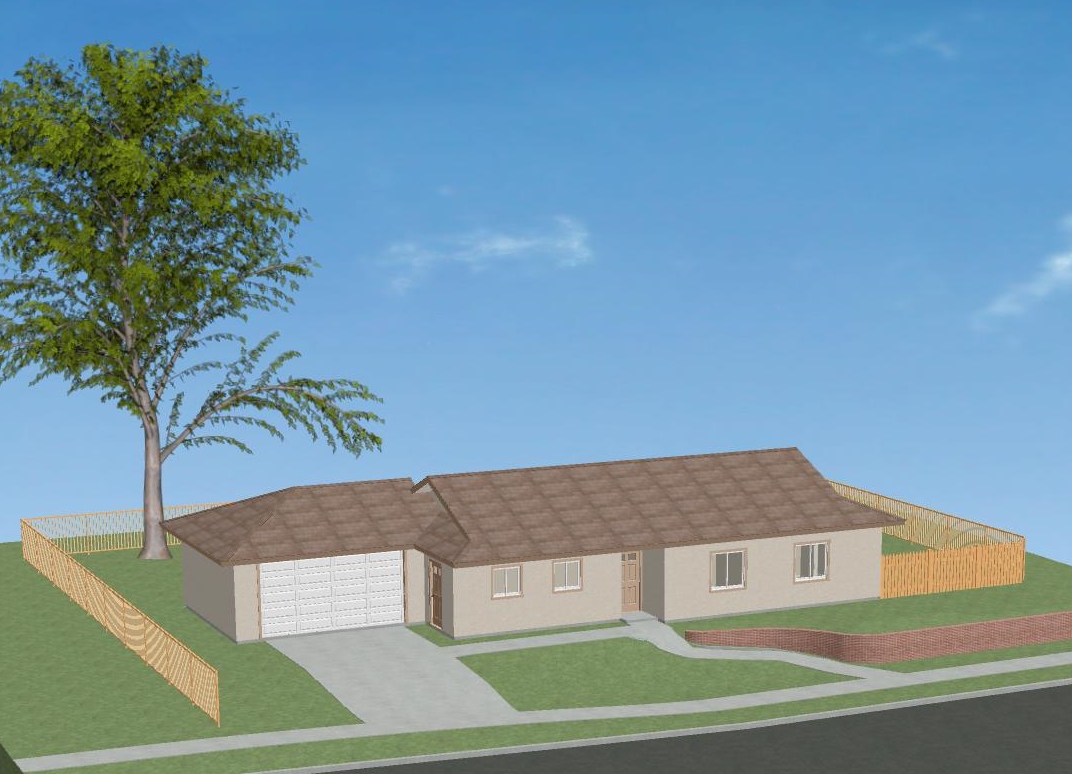
Existing 3D models