Heavy Timber Exposed Trusses – OBC

I love the look and added dimension of open ceilings with timber trusses. They aren’t typically used for structure in California due to strict earthquake structure requirements, but they look great and we can still use them.

Here you see a set of heavy timber trusses – Douglas Fir in this case – being installed in a ICF or insulated concrete form house.

“As Built” Plans

The first step in figuring out how to remodel is to understand what you have! A remodel, by definition, means you already have a house, unlike new construction where you have a blank canvas.

So, I always create the “as built” plans myself (many architects have others do this for them.) One reason is that this way I can really get the feel for the home. How is it built? What kind of framing is used, where are the important structural areas, how has it been improved or added on to over the years, etc. Also every house has its own personality and I feel you need to experience it to understand the flow. All of this information helps inform ways that the house might be altered, added to or changed to suit the scope of the owner’s requirements.

So I go around the entire exterior – photograph everything – measure everything – note the siding, roofing, overhangs, foundation, driveways, hardscape, trees. Then with the outline of the building created, I go inside and figure out how the house is split up with interior wall.

The result is a 36 x 24 inch freehand drawing of the plan of the house.

Then, everything is entered into CAD (computer aided design) which I started using when it first came out in the 90’s. Originally CAD only did two dimensional drawings. Now when I input a house into CAD, I actually build a virtual model of the house in 3d. I can show you the inside and outside “virtually” and we can create various designs that you can actually experience before you start to build.

This is a complete game changer in helping you get the design you want.

Call me – lets talk about your project.

Thx Otis

Say Goodbye Guest House –  Hello ADU

ADU – Isn’t that a horrible name – so institutional?

Accessory Dwelling Unit – not so warm and fuzzy as a cute little guest house nestled in the oak trees … but that’s where we are. You can call it a “guest house” but the city and the county will call it an ADU.

WANTED! – Your cities and towns are heavily promoting ADUs but are they easy to permit and cheap to build?

A baffling variety of ADU’s exist. 
You can have an attached ADU, 
a detached ADU, 
a junior ADU 
or an ADU within an existing accessory structure. 

The states (not only California but all over the US) have put pressure on cities and counties to create more “dwelling units” and they think ADU’s will help.

Additionally, many cities and counties are willing to look the other way from past discretions.  Illegal units can be converted into “legal” units with “Compliance Programs”.  This bizarre challenge has not been successful.  Many previously built “dwellings” are significantly different than current required building codes causing havoc in the “approval process.”  Think about everything from a “Yurt” to a shack that might have been converted….

Building an ADU

Ventura County

With the exception of using the Ventura County pre-approved plans, building an ADU requires all the same steps as building a new house for the most part. Although, I believe the state promotes the idea that they are doing everything to reduce requirements and speed up permitting time, from my experience it isn’t any different. 

Ventura County actually has 3 “pre approved” plans which you can use. 

You can access them here 

Ojai 

Requirements in the city of Ojai are pretty much the same as the County.  You can build a new 1200 SF ADU (1800 SF if you have over 10 acres).  Previously Ojai limited the size of a second “residence’” to 640 SF.

Interestingly, parking requirements change if you build an ADU.  

You can find the Ojai requirements here

The Skinny House

Welcome to The Skinny House!

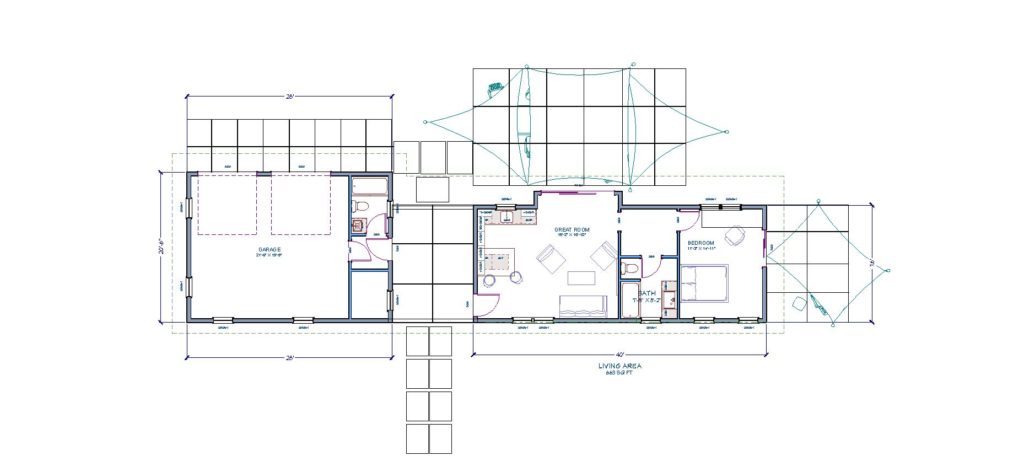
This is a house designed several years ago for Ojai, California. It’s important to note that this is a hot dry climate in a wildfire area.

Part of the objective was to design a simple, efficient, easy to build home that takes some lessons from prefabricated homes.  I often meet with people who are interested in the idea of prefabricated homes only to find out that it’s not always the best solution. For several reasons, including prefabricated homes are not designed site specifically and they are very difficult to change from the standard format. so this exercise was to design something that could be built in this area on a lot facing south with the advantage of being simple and inexpensive to build.

The house faces south and has a large overhanging roof which shades the property. This is passive solar design. Additionally the house would have a solar array on the south-facing roof on top. The house is built with a concrete slab on grade design and standard “stick” or wood frame which is the standard in most of the USA. The concrete is also the finished floor.   The outdoors is used ase outdoor living area. The garage, a building code requirement at the time, is intended to be used as a studio or guest room instead of an actual garage. 

Would this work for you?

Ojai Ranch Remodel

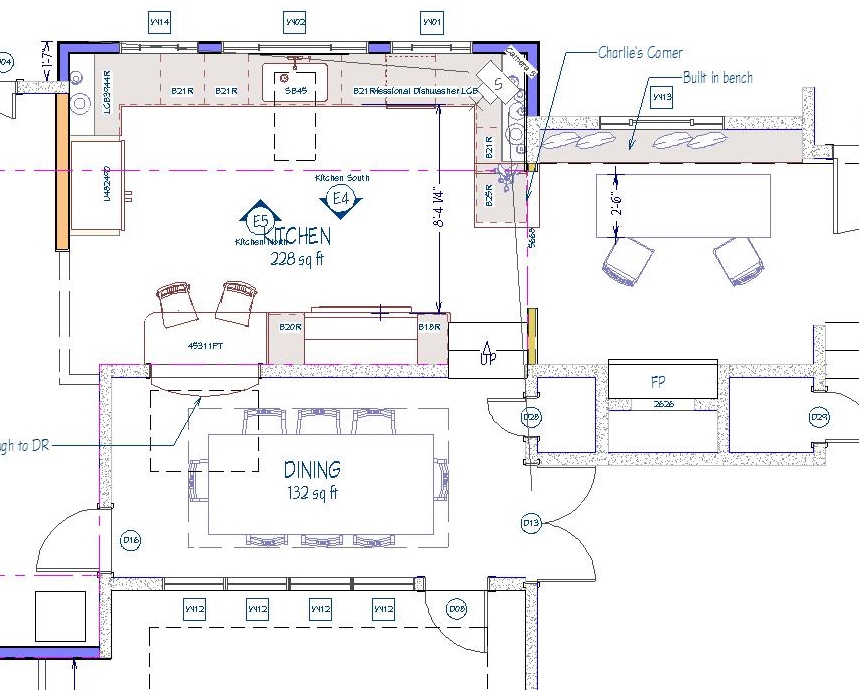
Revised Kitchen

  • move range to opposite wall
  • wrap corner to breakfast nook
  • center sink at windows
  • keep existing openings to Dining Room
Ojai_remodel_Arbolada_kitchen_plan_2016_0131
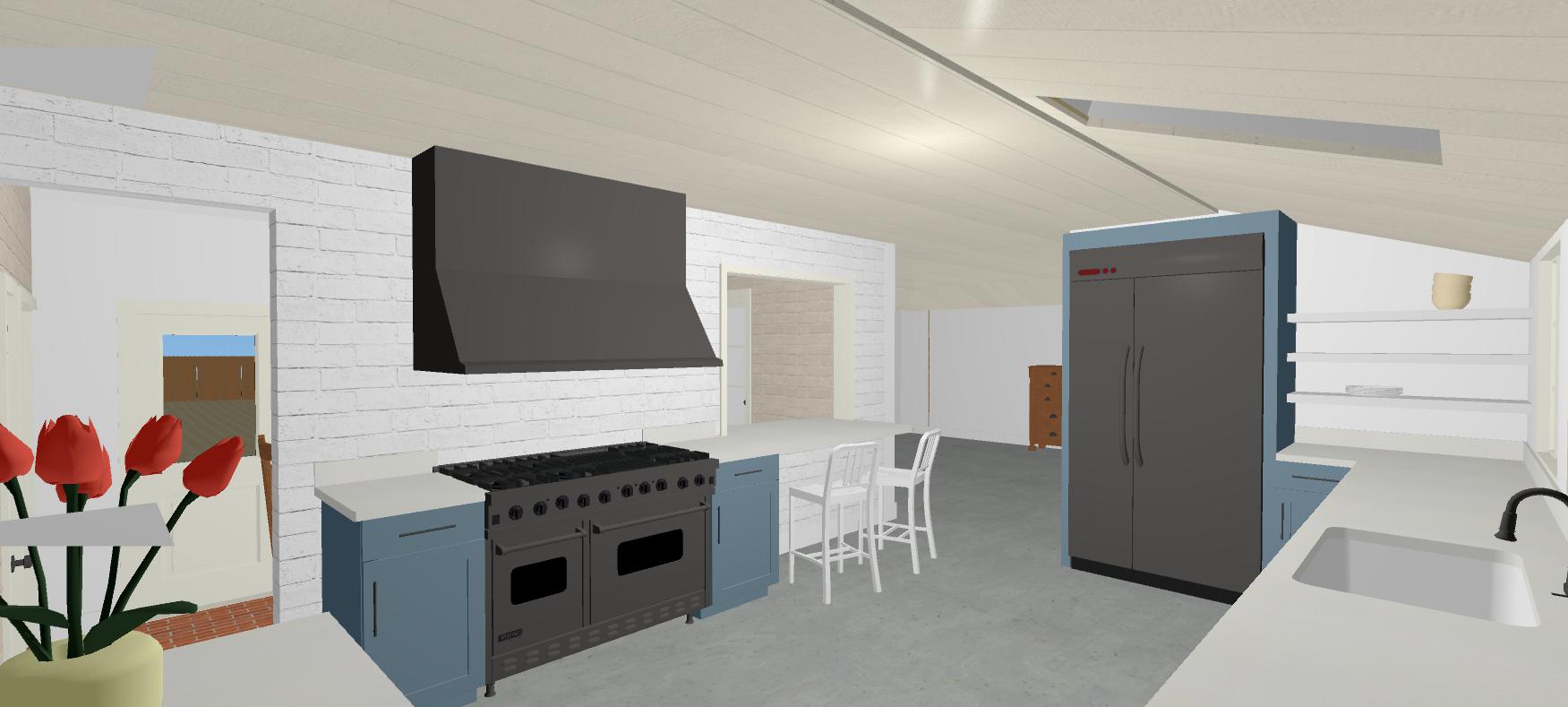
  • View from entry hall
Ojai_remodel_Arbolada_kitchen1_2016_0131

Through breakfast nook to kitchen

Ojai_remodel_Arbolada_kitchen2_2016_0131

Looking towards entry hall and passthrough to dining room

Ojai_remodel_Arbolada_kitchen3_2016_0131

Looking towards breakfast nook

Ojai_remodel_Arbolada_kitchen1_2016_0122

Other side

Ojai_remodel_Arbolada_kitchen2_2016_0122

From Breakfast nook

Master Suite Revision of Option # 2

Plan

  • added double door at bedroom entry
  • moved tub and shower to south wall
Ojai_remodel_Arbolada_Master_plan_2016_0201

Skinny, Tiny, Pre-Fab, Eco House

The “Skinny House” is an idea taken from looking at various pre-fab homes, in particular the high concept, prefabricated Glide House, designed by Michelle Kaufmann. Working with clients over the years, many had seen interesting prefabricated homes in Dwell Magazine and other online architectural place. The idea of having a home built in a factory – better working conditions – better quality – cheaper prices etc – is a hot appeal.

The Glide House

The plan below is an idea that uses many of the concepts of a prefabricated home but a bit bigger and using the garage as a “flex space.” Many people prefer using their garage as a studio, office or other use.

One of the ideas of the “Skinny House” is to incorporate outdoors living space.

Keep construction simple to keep costs down … simple but elegant!

Incorporate solar power …

Often times, after researching the true costs with infrastructure, foundations etc, the actual costs of prefabricated homes are the same or more than building the home on site. A site built home design has much more freedom to be “tweaked” to fit the site. Many options, levels of quality and design exist, but most prefabricated homes are based on components – usually 16 feet wide – that can be transported by truck.

Below – some additional ideas for floor plans.

Prefabricated home companies have been around for years. You mostly know them as trailer park homes. Many of these companies have not evolved past the ugly boxy designs you have seen. A bunch of new companies have come and gone such as Michelle Kaufmann’s Glidehouse. It seems to be – so far – a serious challenge to create the “iHouse” design for homes. A design that works everywhere – works well – is priced well and deliverable everywhere.

A bold objective …

Hygge – a friend of mine recently built this home in Long Island, New York
https://hyggesupply.com/supply/models/

Method Homes
https://methodhomes.net/homes/

Stillwater – in the state of Washington is an interesting company
https://www.stillwaterdwellings.com/designs